BloggSDRangel Meshtastic Dashboard
Creating a web interface for the SDRangel Meshtastic plugin
Sometimes we makers do things that have real value.
Sometimes we do things simply because they seem interesting.
This project falls firmly into the second category.
In a recent blog I introduced the Meshtastic plugin for SDRangel, which allows SDRangel to decode and display Meshtastic packets. The plugin works well and does exactly what it was designed to do. The user interface, however, is very much in the style of SDRangel: functional, information-rich, and aimed at radio enthusiasts rather than casual users.
That got me thinking.
SDRangel exposes a REST API on localhost, which means the decoded Meshtastic data is available to other applications. Once I realised that, the idea of building a dedicated dashboard became difficult to ignore.
The goal was simple:
- Receive Meshtastic packets from SDRangel.
- Decode and process the data
- Store useful information for later analysis
- Display everything through a modern web interface
As is often the case with hobby projects, what started as a small experiment quickly grew into something much larger.
Bildtext här...
From Simple Web Page to Application
My original plan was fairly modest.
I thought I could throw together a web page, display packet information, and call it a day.
It did not take long to discover that things were slightly more complicated.
If I wanted historical data, I needed storage. If I wanted live updates, I needed a backend service. If I wanted to process different packet types, I needed proper decoding. Before long I found myself building a complete application rather than a simple webpage.
Around the same time I decided to use the project as an opportunity to experiment with AI-assisted development.
Since I mostly use free-tier AI tools, that unexpectedly led me into the world of locally hosted language models. While that is a topic for another blog, it turned out to be one of the more interesting side journeys of the entire project.
Architecture
One of the goals from the beginning was to keep the system simple and modular.
Receiving packets, decoding data, writing to a database, and updating web clients all happen at different speeds. Rather than trying to do everything in one place, I separated the application into independent components connected by queues.

SDRangel Meshtastic Dashboard Architecture
The flow is straightforward:
- SDRangel receives and forwards Meshtastic packets.
- The dashboard decodes the packet contents.
- Useful information is stored in an SQLite database.
- Live events are pushed to connected browsers using WebSockets.
This approach ended up being much easier to work with than I originally expected. Each component has a single responsibility, which makes the system easier to understand, debug, and extend.
At some point during development I realised I was no longer building a web page.
I was building an application.
Processing the Data
Receiving packets is only the beginning.
Meshtastic packets contain information about messages, telemetry, node details, and position reports. Once decoded, that data can be transformed into something much more useful than a stream of raw packet bytes.
The dashboard stores information in a lightweight SQLite database, allowing historical data to be reviewed long after the packets have been received.
I chose SQLite because it is simple, reliable, and requires virtually no administration. For a project like this it provides everything needed without introducing unnecessary complexity.
An added bonus is that the database can easily be opened with external tools such as DBeaver for anyone who wants to explore the data directly.
Real-Time Updates
One feature I knew I wanted from the beginning was live updates.
There is something satisfying about seeing information appear immediately as packets are received.
Using WebSockets, connected browser clients receive updates as soon as new packets are processed. Messages, telemetry information, and node updates appear almost instantly without requiring page refreshes.
For a monitoring dashboard, this creates a much nicer experience than repeatedly pressing refresh and hoping something new has happened.
User Interface
The dashboard runs as a local web application and is accessed through a standard browser.
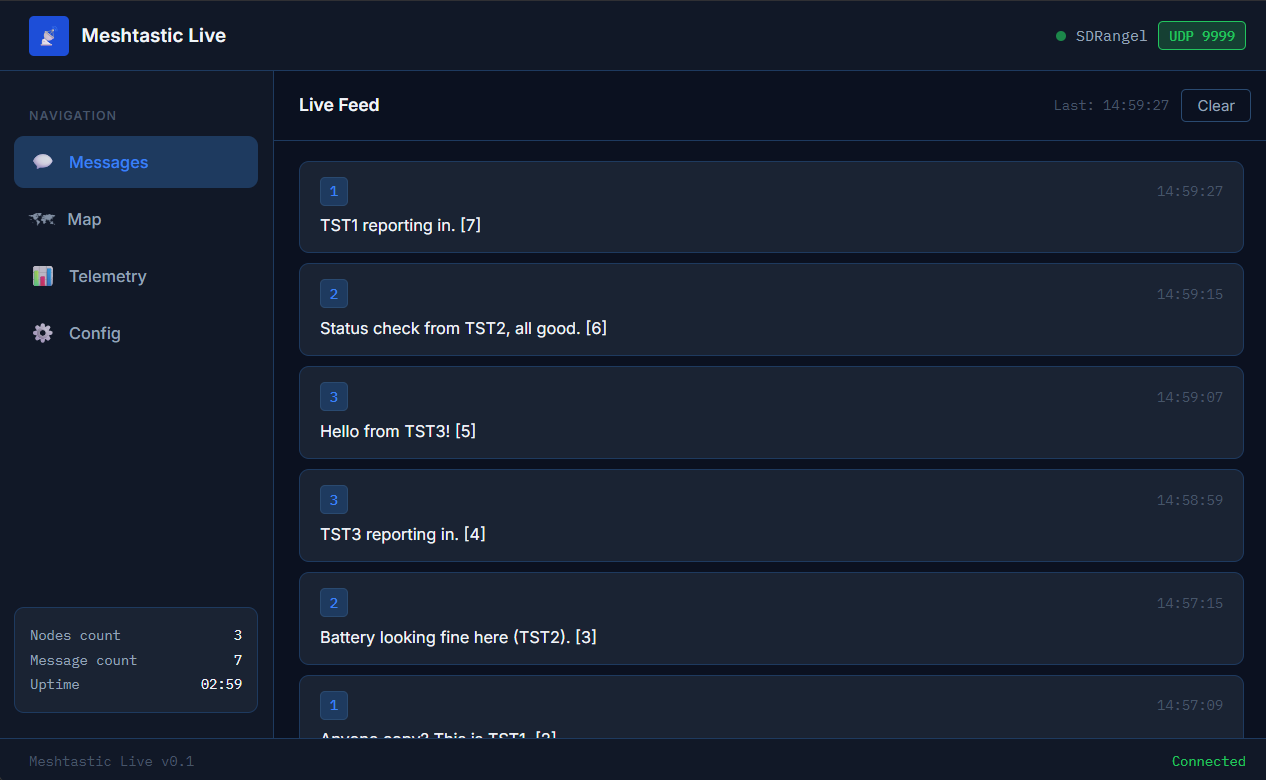
Message Board
Current views include:
- Messages
- Map
- Telemetry
- Configuration
The Messages page provides a live feed of network activity and serves as the default landing page.
The Map view displays nodes that have reported position information.
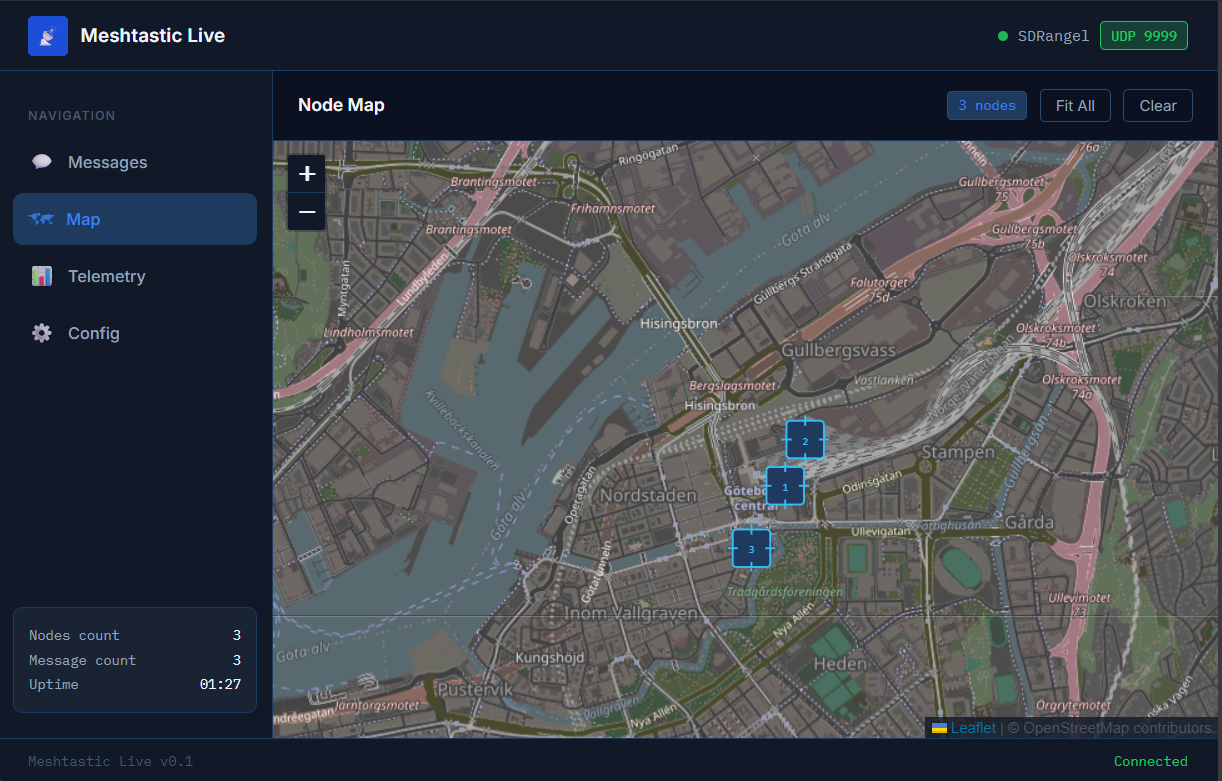
Map View
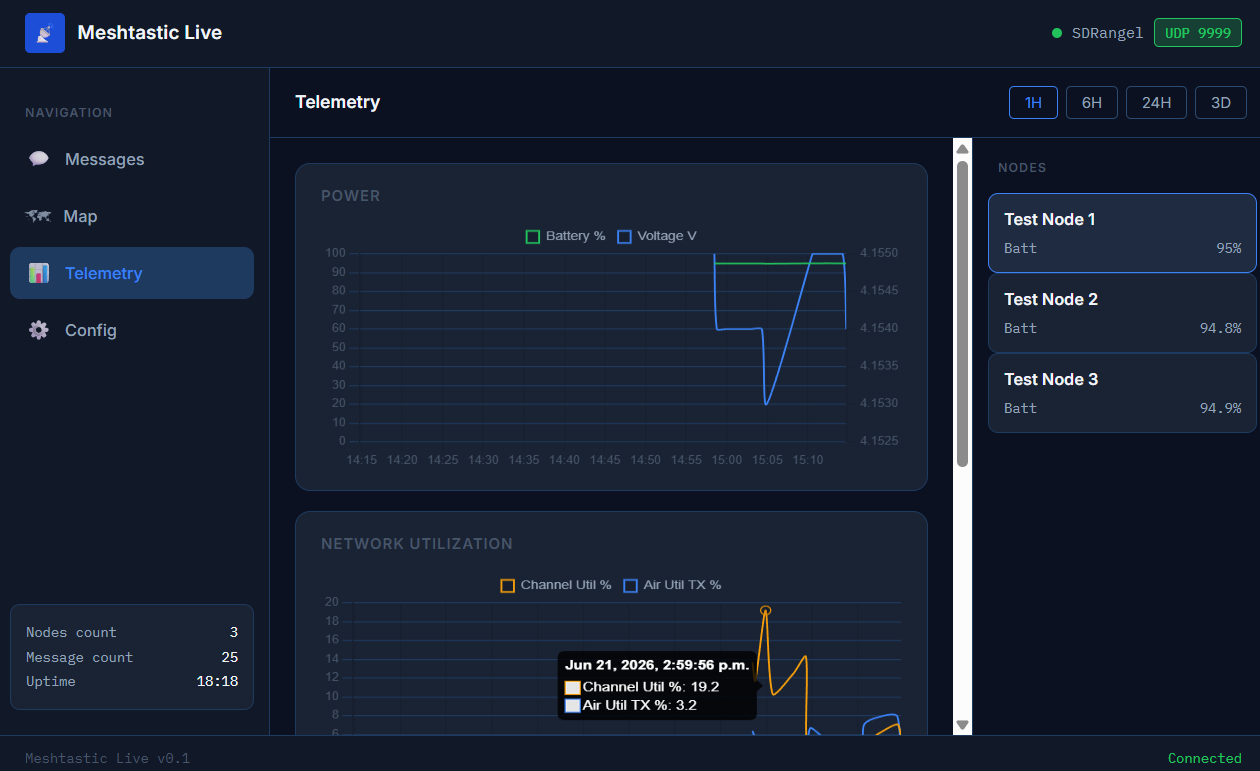
The Telemetry view shows information such as battery levels and environmental sensor readings when available.
Throughout the design I tried to focus on displaying the information I would personally want to see at a glance while monitoring a network.
What I Learned
As I mentioned at the start, this project was never really about solving a major problem.
The SDRangel plugin already works.
The dashboard was simply an excuse to learn something new.
One thing that surprised me was how approachable event-driven development turned out to be. Before this project, concepts such as queues, asynchronous tasks, and WebSockets felt like things used by much larger systems. In practice, breaking the application into small independent components actually made the code easier to understand.
This was also my first serious project using FastAPI, and I can understand why it has become so popular within the Python community. Building REST endpoints, serving web pages, and handling WebSockets all felt remarkably straightforward.
Perhaps the biggest takeaway, however, is something I have discovered repeatedly while experimenting with Meshtastic.
Meshtastic is far more than a messaging platform.
It is an ecosystem that encourages experimentation.
One day you might be testing antennas. Another day you are working with sensors. Before you know it, you are building databases, web applications, and experimenting with local AI models because of a radio project.
That is part of what makes it so enjoyable.
Future Plans
The dashboard is still a work in progress.
One feature I would like to add is the ability to manage configuration directly through the web interface rather than editing configuration files manually. Additional network statistics and monitoring capabilities would also be useful.
Whether all of those ideas actually get implemented remains to be seen.
As with many maker projects, the journey is often more interesting than the destination.
If you would like to explore the code, suggest improvements, or simply see how the project is put together, the source is available on GitHub.
SDRangel_meshtastic_dashboard_mkII
In the end, this project started as a small idea, grew into something much larger than expected, taught me a great deal, and was a lot of fun to build.
That alone made it worthwhile.
Written by JohanV — 2026-07-05