BloggNoise is in the Air
During our Swedish summer vacation I was visiting South Africa and, much to the frustration of my family, I don't just travel with my passport. I have to take all my toys with me as well.
One afternoon I unpacked my RTL-SDR, connected it to my laptop, and started watching the 869 MHz band in a much higher populated urban area than back home. Compared to what I normally see back home in Sweden, the waterfall looked like complete chaos.
Although South Africa follows its own regulations (ICASA), the band is used by very similar IoT devices as in Europe.
Signals appeared everywhere. Some lasted only milliseconds. Others swept across the display like little comets. There never seemed to be a quiet moment.
My first thought was simple.
"There is so much noise here."
I was wrong.
Learning to see
One of the wonderful things about software defined radio is that it changes the way you look at the world.
Before buying an SDR, radio was something invisible.You knew it existed. Wi-Fi worked, your car unlocked, weather stations updated and messages appeared on Meshtastic.
But you never actually saw any of it.
Then you install SDRangel or SDR++, tune to a frequency, and suddenly the invisible becomes visible The waterfall comes alive.
It isn't noise...
The longer I watched the spectrum, the more I realised I wasn't looking at random interference. I was watching an entire neighbourhood talking to itself. Every little burst had a purpose.
A smart electricity meter quietly reporting its usage or a weather station sending the latest temperature. An alarm sensor checking that everything was still secure and a garage door is opening. Even a LoRaWAN device reporting data back to a gateway.
And somewhere in amongst all those conversations...a Meshtastic node saying hello to another Meshtastic node.
Every transmission represented a device doing exactly what it had been designed to do. The waterfall wasn't showing chaos. It was showing life.
I got curious enough afterwards to actually go and identify who all these "neighbours" are. It turns out the 868 MHz band has quite the guest list.
Meet the neighbours
If you park a spectrum analyser on 863–870 MHz in almost any European town, here's roughly who shows up.
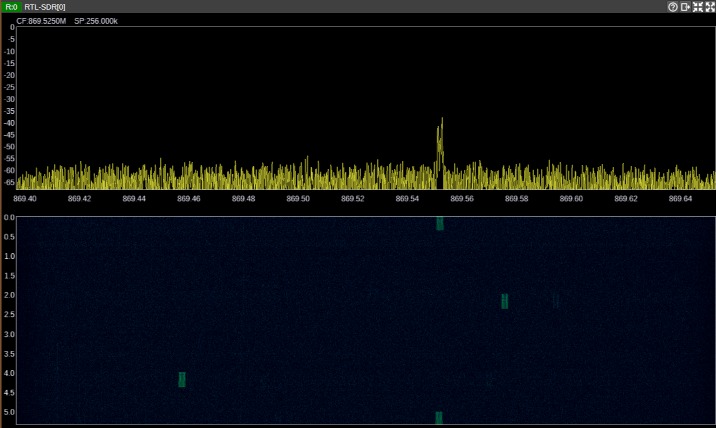
Smart meters. Most electricity, gas, and water meters in Europe report over a standard called Wireless M-Bus. Some only phone home a few times a day (Stationary mode). Others, running the newer Compact mode, are chattier. Either way, on the waterfall they look like short, sharp double-tone blips, two thin lines flicking on and off for a few tens of milliseconds. In a block of flats with forty apartments, that's forty independent little voices, each blind to the other thirty-nine.
Home automation, most commonly Z-Wave. Unlike almost everything else on this list, Z-Wave sits on one single, fixed frequency, 868.42 MHz, dead center in the band. It's narrowband, low power (about 10 mW, roughly 4,000 times weaker than your mobile phone), and only blinks when a switch, sensor, or thermostat actually has something to say.
Alarm systems. Door sensors, motion detectors, panic buttons. Regulators actually carved out dedicated sub-bands just for these, 868.60–868.70 MHz and a couple of slivers up near 869.3 and 869.65 MHz, specifically so alarm traffic gets a quiet, low-duty-cycle lane of its own. Most of the time these sensors say nothing at all. When they do, it's a brief two-tone FSK burst, and then silence again for minutes at a time.
Weather stations. These are the metronomes of the band. A typical consumer weather sensor reports every 30 to 60 seconds like clockwork, rain or shine — solar-powered ones will even throttle themselves back in low light to save energy. If you see a signal that repeats with almost boring regularity, there's a good chance it's someone's outdoor temperature sensor.
Garage doors, gates, and keyless remotes. These are the opposite of predictable. They only exist because a human pressed a button. No pattern, no schedule, just an isolated little burst, once in a while, whenever someone comes or goes.
LoRaWAN. The professional cousin of Meshtastic. Same chirp modulation, same general neighbourhood of the band, but it lives mostly in its own tidy channel grid around 868.1- 868.5 MHz, reporting sensor data back to a gateway rather than mesh-hopping between peers.
And, of course, Meshtastic itself which, interestingly, doesn't actually sit where most of the above do. More on that in a moment.
Every protocol has its own accent
Once you spend enough time watching an SDR waterfall, you begin to recognise different "accents."
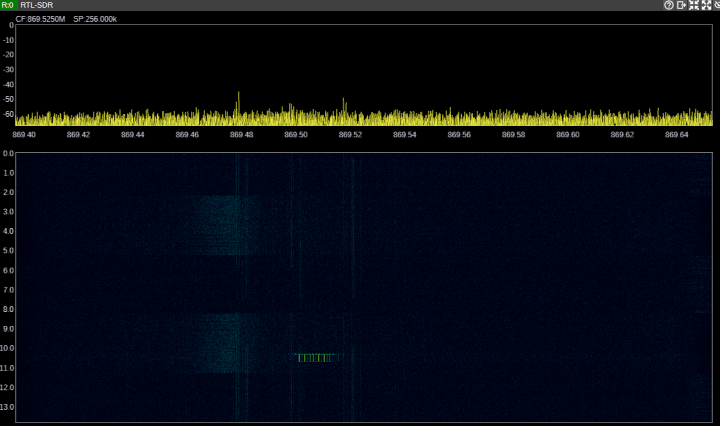
LoRa transmissions, Meshtastic and LoRaWAN alike, don't look like ordinary radio signals. They sweep across the channel as beautiful diagonal chirps, rising or falling in frequency over the length of the packet. Nothing else on the band looks quite like it.
Smart meters produce quick little bursts, while weather stations tick along like clockwork. Alarms stay quiet for ages and then say one urgent thing and then of course garage remotes appear only when someone presses a button.
The more you watch...the less random it all becomes.
It's a little like standing in the middle of a busy city. At first all you hear is noise. Then you start picking out individual conversations.
The quietest neighbours
One thing surprised me while researching this article. Most of these devices hardly transmit at all.
In Europe they're required to share the spectrum politely, under rules set out in ETSI EN 300 220. Depending on which slice of the band a device sits in, it might be allowed to transmit for as little as 0.1% of every hour, that's about 3.6 seconds, total, per hour. Even the more generous slices usually cap out around 1%.
That means your electricity meter isn't constantly transmitting, neither is your weather station or your alarm system. Each one says what it needs to say....and then goes silent again.
The result is something rather beautiful: thousands of independent devices, none of them knowing the others exist, none of them coordinated by any central authority, somehow managing to coexist remarkably well, purely because everyone plays by the same statistical politeness rules, with nobody actually enforcing them in real time.
There's no 868 MHz air traffic controller. It just...works, most of the time, because everyone keeps their transmissions short.
The real noise
Of course, real radio noise does exist.
Thermal noise is always there, a genuinely random hiss set by the physics of the receiver itself, present even in a perfectly silent room with no other transmitters nearby.
Electronic devices generate interference too. Switch-mode power supplies, LED drivers, and cheap USB chargers can all raise the background noise floor. And here's the counterintuitive part: a switching supply's interference doesn't necessarily get quieter as you tune higher in frequency. Its sharp, distinct harmonics at low frequencies tend to blur together into what just looks like a featureless, elevated noise floor higher up the band. So sometimes what you think is "lots of activity" on the waterfall might genuinely just be one badly-filtered charger in the room next door, not many devices at all.
Once you know that, something interesting happens. The bursts become far more interesting than the background.
Instead of asking:
"Why is there so much noise?"
you start asking:
"Who is talking?"
Why Meshtastic works so well here
This is one of the reasons I enjoy using Meshtastic.
For one thing, it doesn't even compete for the same crowded corner of the band as most of the neighbours above. In Europe, Meshtastic mostly operates around 869.4–869.65 MHz, a deliberately generous sub-band that trades a narrower slice of spectrum for a much more permissive 10% duty cycle, rather than the tighter 1% (or less) that smart meters and sensors have to live with. It's the same sub-band LoRaWAN reserves for its own gateway-to-device traffic. Different neighbourhood entirely from your smart meter.
But even where it does share a channel, LoRa has a trick up its sleeve.
At first glance, the band appears crowded. Yet Meshtastic continues to perform remarkably well, and the physics behind it is genuinely strange if you're used to thinking about radio the ordinary way.
Normally, a receiver needs a signal to be louder than the noise around it to pull it out. LoRa doesn't play by that rule. Its chirp spread spectrum modulation lets a receiver patiently accumulate correlation energy across an entire packet, and that lets it decode a signal that's up to 20 dB below the noise floor. That's not a signal that's quieter than the noise. That's a signal literally 100 times weaker than the noise around it, and the radio still gets it.
There's a second, equally strange effect at play too: the "capture" effect. When two LoRa signals collide on the same channel, the receiver doesn't necessarily fail, it tends to lock onto whichever one is strongest, provided it's roughly 16 dB or more above the other. And because radio power falls off so steeply with distance, that "strongest" signal is very often not the most powerful transmitter out there, it's simply the nearest one. A tiny node a few metres away can dominate the channel over a much more powerful transmitter kilometres off, purely because of how fast signal strength collapses with distance.
Put those two effects together and you get something almost poetic: to us the waterfall may look like an overwhelming wall of noise. To a LoRa receiver, it's just a room full of different voices speaking different languages, and it's remarkably good at picking out the one it's listening for, sometimes because that voice is close, and sometimes, more strangely, precisely because it isn't loud at all, just coherent.
It's rather clever engineering.
Listen with your eyes
If you own an SDR, here's a challenge.
Open the waterfall and simply watch, don't immediately start looking for Meshtastic packets, watch everything. Notice the repeating signals, the random ones. Ask yourself what each one might be. A smart meter? A weather station? Someone coming home and pressing their gate remote? You'll probably never identify every signal. I certainly can't.
But you'll start to appreciate something we rarely think about. The air around us isn't empty. It's alive, not with noise, but with conversation.
Once you've seen it that way...it's impossible to unsee.
Written by JohanV — 2026-07-19