BloggMeshcore in Jönköping – My Experiences So Far
I’d been running Meshtastic for a short while when Meshcore started appearing in conversations around Jönköping. If I am being completely honest, I wasn’t entirely convinced at first.
Our local community is still relatively small, and splitting attention between two entirely different LoRa mesh projects sounded like a good way to make them both weaker. Meshtastic already worked, people were using it, and we were slowly but surely building out coverage around town. Why introduce something else and fracture the user base? Still, the more I looked into the core routing mechanics of Meshcore, the more my curiosity got the better of me.
Testing the Hardware & Mapping the Valley
Before getting into Meshcore, I’d already spent a significant amount of time experimenting with Meshtastic. Like many projects of this type, it started with whatever hardware happened to be lying around in my parts bin.
I dug out a Waveshare RP2040 LoRa board and later added a Heltec v3 and a Wireless Stick to the collection. The hardware side is always a bit of a trial-and-error process.
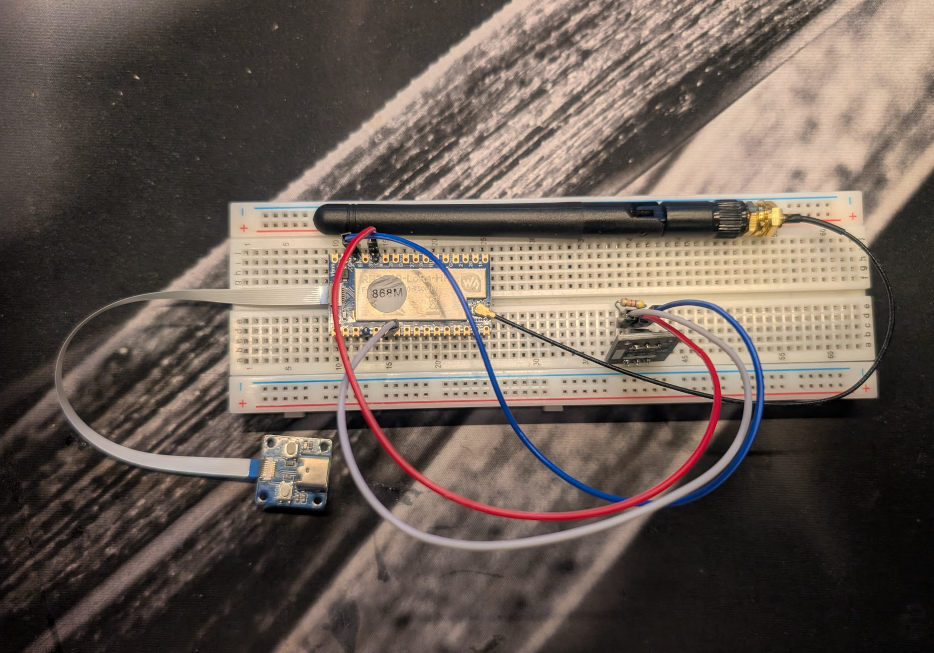
Waveshare RP2040 LoRa
At one point during my Meshtastic testing, I modified the firmware so the nodes would automatically respond with signal strength and SNR (Signal-to-Noise Ratio) information whenever pinged. It was essentially a homemade, automated version of Meshmapper. I mounted these different boards in a west-facing window at home, which gives a good view across the lake, and spent a few weekends driving around Jönköping collecting raw measurements.
The results of those early drives were eye-opening, showing that the differences between seemingly similar boards can be massive in real-world conditions. More importantly, it gave me a much better understanding of how radio coverage actually behaves around our town. RF maps and line-of-sight specifications only tell a fraction of the story. Hills, concrete buildings, and local terrain matter a lot more than many people realize when they first buy a node.
Discovering Meshcore's Routing Model
Around this time, `Jesper` started talking more seriously about Meshcore. What caught my attention this time wasn’t a shiny new user interface or a list of consumer features. It was the protocol, the routing model, and how it utilizes our limited radio spectrum.
Meshtastic and Meshcore solve the exact same problem, getting a packet from point A to point B without cellular infrastructure, but they do it in completely different ways.
Meshtastic relies on a flooding approach. When a node hears a packet, it retransmits it. Other nodes hear that retransmission and broadcast it yet again. This is incredibly robust for spontaneous, ad-hoc networks because nodes can appear almost anywhere unexpectedly and communication still magically happens. However, the downside is that it gets incredibly noisy. As a local community grows, the airwaves can quickly get clogged with overhead, duplicate packets, and unnecessary channel utilization.
Meshcore takes a much more structured, deliberate approach. It splits nodes into distinct roles. Dedicated repeater nodes advertise themselves, map their neighbors, and build intelligent routing tables. Companion nodes: the ones you carry in your pocket, leave on your desk, or mount in your car, do not participate in forwarding traffic for others at all. They remain completely silent on the airwaves, only breaking radio silence to transmit via the repeater infrastructure when you actually type out and send a message.
The first approach is highly flexible; the second is hyper-efficient with airtime. Neither is automatically "better" than the other. But the more I read about it, the more I realized that a structured network might fit a permanent, long-term city setup much better than a chaotic flooding network.
Building the Backbone Over Vättern
Eventually, the urge to experiment won. I took down my Meshtastic test setup, printed a simple ABS enclosure to protect the hardware, and reflashed the boards with Meshcore. I also convinced my friend `ZF` to get involved. His node was placed roughly 6.5 kilometers away and has a beautiful, clear line of sight right over Lake Vättern to my place.
The initial link worked almost immediately. A 6.5 km path over open water is well within what a LoRa signal can achieve, and it gave us a fantastic, stable baseline to compare how different hardware handled the Meshcore firmware.
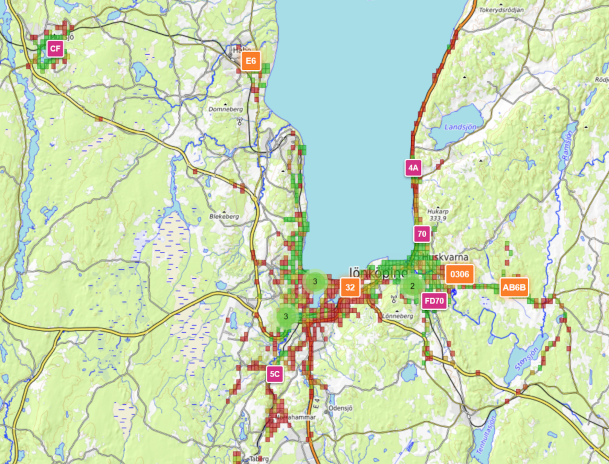
Meshcore status
What really surprised me, though, was what happened over the following weeks as other repeaters started popping up around the region.
Routes started forming dynamically without us having to manually configure them. Before long, my messages were hopping through several repeaters, reliably making their way all the way to `Jesper` on the south side of town. The network was still relatively small, more a line than a mesh. But for the first time, it stopped feeling like a scattered collection of isolated garage experiments and started feeling like a real, engineered communications system.
Choosing the Right Tool for the Job
Spending time deep in the weeds with both systems has completely changed how I look at mesh networking as a hobby.
Meshtastic excels when simplicity and absolute autonomy matter most. If you want to flash a few boards, hand them to a group of friends, go for a weekend hiking trip, attend a crowded public event, or set up a quick emergency communications in an area with zero infrastructure, Meshtastic has benefits. The network forms itself out of thin air and requires zero advanced planning.
Meshcore shines when you want to build permanent, scalable infrastructure. Because companion nodes remain silent, their battery life is vastly superior. The heavy lifting of routing is delegated entirely to mains-powered or solar-powered repeaters, keeping the RF spectrum clean, quiet, and predictable as more users join. The obvious trade-off is structural: someone actually has to build, site, and maintain those repeaters. If nobody steps up to install the backbone infrastructure, there simply is no network.
That is why I have stopped viewing Meshcore as a direct replacement or a "rival" to Meshtastic. They are solving entirely different problems. Meshtastic is fantastic for ad-hoc, temporary communication. Meshcore is built for a planned, long-term, community-wide infrastructure network.
Getting Started & The Software Experience
If you are curious about trying Meshcore yourself, the barrier to entry is incredibly low, and the software experience is honestly refreshing. One of my favorite details is how clean the companion application is. You don't need to go to an app store, download a bloated application, or hand over an email address to create an account. The companion app is a lightweight web app that runs directly out of your browser, utilizing the Web Bluetooth API to talk straight to your hardware node.
The web-based flasher at (meshcore.io) fully supports a wide range of popular hardware, including the newer Heltec T096 boards. You can genuinely have a companion node up, flashed, and running on your desk in just a few minutes.
You don't need a massive expensive rooftop tower mast or a perfect hilltop site to participate, a simple repeater in the window of your appartment is also valueble. Every single new node location teaches us something new about how these 868 MHz signals bounce around the local buildings and terrain.
Looking Ahead
We are still very much in the learning and experimenting phase. The hilly terrain surrounding Jönköping presents plenty of unique RF challenges, and there are still several major coverage gaps around town that we are itching to close. One of our current group goals is figuring out a reliable path to bridge the gap the home of `ZF` through dense forrest and over a particularly inconvenient set of hill ridges, a distance of roughly 25 kilometers.
Reaching those goals simply means more driving around with radios, building more custom antennas, and running more weekend experiments. But let’s be honest, that is easily half the fun of the hobby anyway.
If any of this sounds like your kind of project, feel free to join in. Whether you are interested in Meshcore, Meshtastic, antenna propagation, writing firmware, or simply seeing just how far a tiny, fraction-of-a-watt LoRa signal can travel across Jönköping County, there is always another experiment waiting to be tried. Grab a board, flash it, and we'll see you on the mesh.
Written by louie — 2026-06-07