Meshtastic in commercial applications
Can I Make Money with Meshtastic?
Speaking to friends and reading online, I’ve noticed a pattern: a lot of people think Meshtastic is just a hobby gadget. A toy. Something hikers use to stay in touch — or maybe a tool for “when the big one hits” and the cell towers go dark.
That got me thinking: If I had a great idea, could I — and am I even allowed to — use Meshtastic in a real-world commercial solution?
This isn’t legal advice (I’m not a lawyer), but let’s pull apart the Meshtastic ecosystem layer by layer and see what’s possible.
The Hook: Could Meshtastic Power a Startup?
Could you run a delivery tracking service entirely over Meshtastic?
What about a community security alert network?
Or even a subscription-based weather data service?
Before you start buying domains, we need to look under the hood — because licensing, spectrum rules, and firmware freedoms will decide if your idea flies or fizzles.
Real-World “What Ifs”
- Weather Station Network – 20 nodes across a city collecting hyperlocal data. Customers subscribe to see the live feed.
- Neighborhood Alert System – Residents pay a small fee for instant safety alerts sent over Meshtastic.
- Farm Asset Tracking – Rental trackers on livestock and equipment, all meshing together to cover rural dead zones.
Each of these touches different parts of the Meshtastic stack — and that’s where the rules start changing.
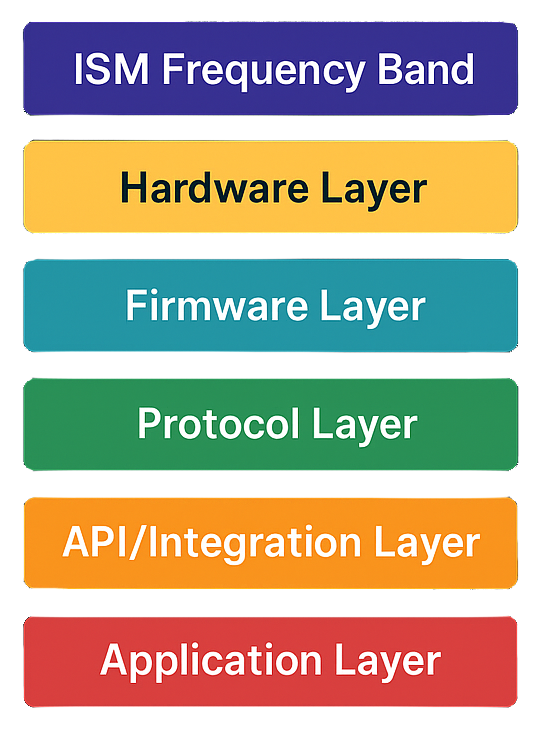
The Meshtastic Stack
- ISM Frequency Band – The spectrum your radios transmit on.
- Hardware Layer – LoRa-enabled devices (often with Bluetooth/Wi-Fi).
- Firmware Layer – The Meshtastic firmware running on your hardware.
- Protocol Layer – How devices actually talk to each other over the air.
- API/Integration Layer – How your app or service plugs into the network.
- Application Layer – The product or service your customers see.
1. ISM Frequency Band – The Layer Zero Checkpoint
If you can’t legally transmit, your idea stops here.
In the EU, ISM (Industrial, Scientific, and Medical) bands can be used for commercial applications — and they already power Wi-Fi, Bluetooth, RFID, smart meters, and IoT systems.
- License-free use (if you follow EU spectrum rules).
- Must comply with harmonized standards like ETSI and CE requirements, including power limits and duty cycle restrictions.
- No protection from interference — you share the band with everyone else.
2. Hardware Layer – The CE Mark Gatekeeper
From an EU perspective, your hardware needs a CE mark. Designing your own means meeting CE requirements; using vendor hardware from companies like Heltec, RAK, LILYGO, or Seeed Studio can shortcut the process.
LoRa note: Semtech owns the LoRa trademark and patents the modulation tech, but using LoRa chips in your products does not require royalties or per-device fees.
3. Firmware Layer – The Heart of Meshtastic
The Meshtastic firmware is licensed under GPLv3, which grants you the right to run, study, share, and modify it — as long as you share your modified source code under the same license.
- If you modify the firmware, you must make your changes public.
- You can still sell hardware or services powered by it.
- You must follow the Meshtastic trademark guidelines.
Fun fact: the core contributors even formed Meshtastic Solutions to help support and scale commercial builds on Meshtastic.
4. Protocol Layer – Where the Mesh Lives
The protocol is open to build on, extend, and integrate. The challenge: balancing public access with commercial reliability, and avoiding network flooding that could hit duty cycle limits.
I’ll dive into mesh design strategies in a future post — it’s a topic that deserves its own deep dive.
5 & 6. API/Integration Layer and Application Layer – Your Playground
The Python API uses the GPLv3 license. Your application layer — the product or service — is fully yours to own and monetize.
Feasibility Snapshot
| Layer | License / Restriction | Commercial Feasibility |
|---|---|---|
| ISM Band | Spectrum rules & duty cycle | ✅ High |
| Hardware | CE mark, vendor dependent | ✅ High |
| Firmware | GPLv3 | ⚠ Medium (share mods) |
| Protocol | Open spec | ✅ High |
| API/Integration | GPLv3 | ✅ High |
| Application | Your own | ✅ High |
My Takeaway
Yes — you can make money with Meshtastic. The hardware and protocol are business-friendly, the ISM band is open to commercial use in the EU, and the firmware license is workable if you’re okay sharing modifications.
The real work will be in designing your mesh for reliability — and I’ll be covering that in my next post.
So — what’s your big idea? Weather networks? Smart farming? Community safety? Whatever it is, I’d love to see it make the world better with Meshtastic.
Written by JohanV
2025-08-16