When It Comes to Antenna Gain, Is Bigger Better?
Understanding dBi and how antenna gain impacts your Meshtastic network
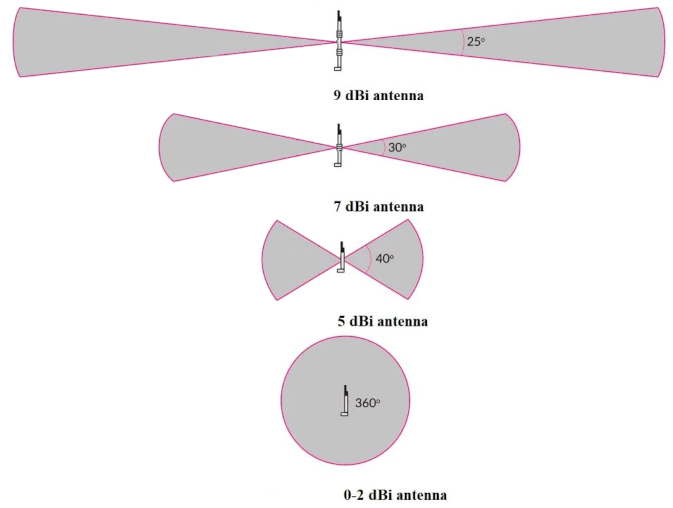
If you've spent any time exploring Meshtastic or other radio-based communication networks, you've probably come across the term "antenna gain." It's one of those technical-sounding phrases that can seem a bit mysterious if you're just getting into the world of radios and antennas. But understanding it—at least at a basic level—can really help you get better range and performance out of your setup.
Recently, community member SA7GAM shared a great hands-on experience comparing antennas with different gain levels, and it sparked a deeper conversation about what dBi really means and how it affects performance in different environments. So let’s dive into it.
What is dBi?
dBi stands for decibels relative to an isotropic radiator. That sounds a bit intimidating, but here’s the simple version:
Imagine an ideal antenna that radiates signal equally in all directions—like a perfect glowing ball of signal. That’s the "isotropic radiator." Real antennas focus the signal more in certain directions. dBi is a measure of how much stronger the signal is in its best direction compared to that perfect glowing ball.
So, more dBi means the signal is more focused in one direction (like turning a lightbulb into a flashlight). Less dBi means the signal spreads out more evenly (like a lantern).
- 3 dBi: Wide coverage, good for urban areas, forests, and hilly terrain.
- 6 dBi: A balance—slightly more range, still relatively broad coverage.
- 9 dBi: Long range in open areas, but struggles with obstacles like buildings or trees.
What Are Directional Gain Antennas Good For?
Antennas with higher dBi (like 6 or 9) focus your signal more narrowly. That’s great when you want to talk over a longer distance and the path is clear—say, across a lake or open field.
But in a city, forest, or hilly area, that narrow beam might miss other nodes entirely if they're not in the “sweet spot.” That’s where a lower-gain antenna (like 3 dBi) shines, because it spreads signal more evenly in all directions.
Think of it like this:
- High dBi: Spotlight – great for distance, bad for blind spots.
- Low dBi: Lantern – less range, but better all-around coverage.
Member Experience: SA7GAM's Field Test
"I performed a test with a vertical antenna (~ 3 dBi) installed on my repeater at home. In my hand I had a HelTtc V3 device equipped with both a 3 dBi 'Stubby' antenna and an approximately 6 dBi antenna. The location of the test was at the water pipeline. First I used the little 3 dBi antenna. The result was very positive—I got direct response both via Traceroute and on the Longfast channel. Then I switched to the 6 dBi antenna in exactly the same place. Surprisingly, I got no response at all. I quickly switched back to the 3 dBi antenna and communication again worked flawlessly."
This test was a perfect real-world example of how a more focused signal can miss nodes that a wider one can reach. Even though the 6 dBi antenna should give more range, it was too directional in this specific terrain.
Conclusion
So—is bigger better? When it comes to antenna gain, not always.
Higher dBi antennas can give you impressive range, but only when conditions are ideal—flat terrain, few obstacles, and a clear line of sight. In more complex environments, like cities, forests, or valleys, a lower dBi antenna might actually give you more reliable communication.
In Meshtastic networks, where nodes might be tucked behind trees, hills, or buildings, don’t automatically reach for the biggest antenna. Think about the environment, and choose the antenna that best fits your needs.
Thanks again to SA7GAM for sharing their test and helping us all learn a bit more about the magic (and science) behind antennas!
For more about antennas visit Antenna Theory Tutorial.
Written by JohanV
2025-06-15